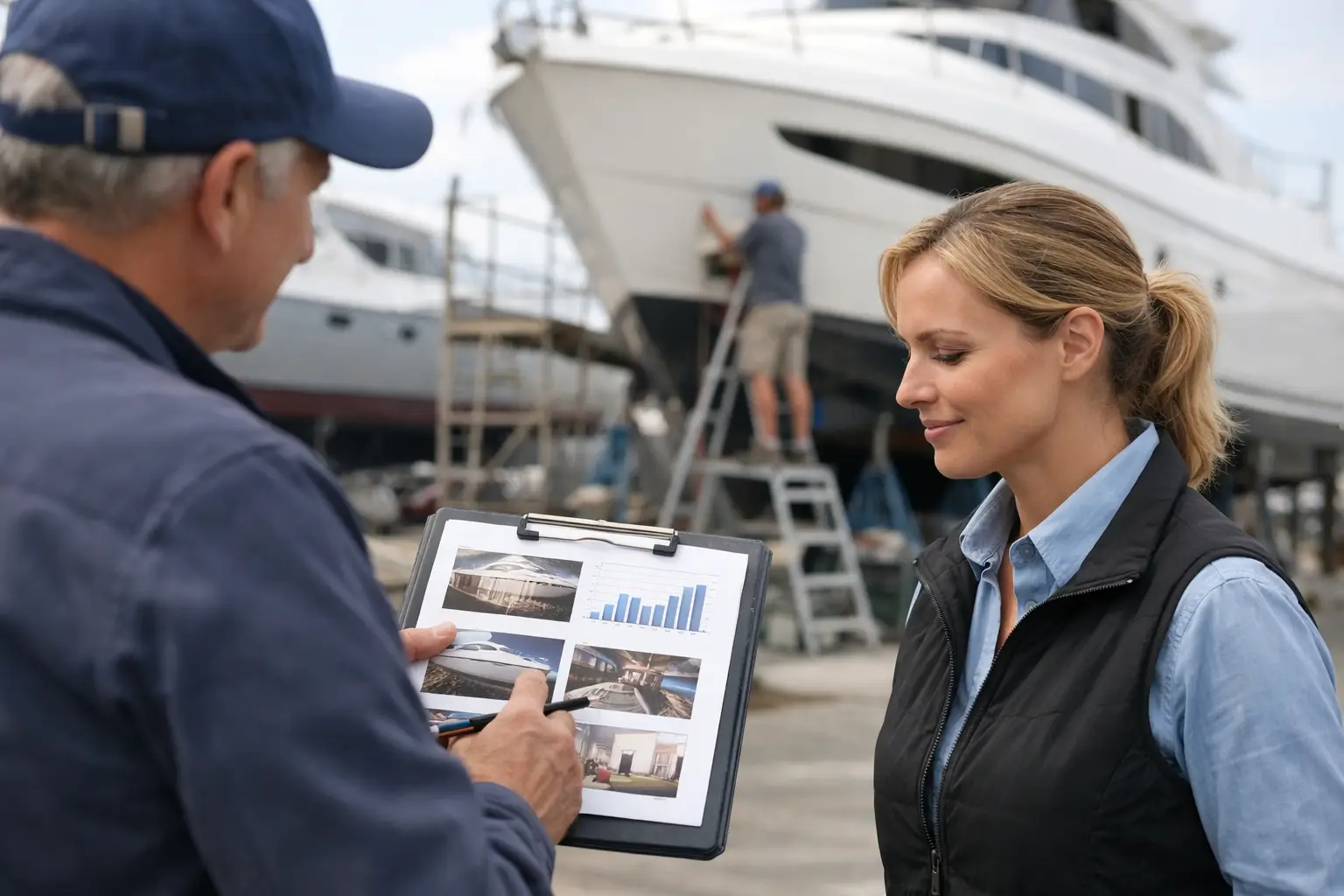
Boatyard Progress Reports That Clients Trust
A client has already paid a deposit on a refit, repair, or custom build. The boat is in your yard. Weeks pass, then months. From the client’s side, silence feels risky fast. That is why boatyard progress reports matter so much – not as admin for your team, but as a practical way to maintain trust while work is still underway.
In a boatyard, progress is rarely linear. One week is demolition and inspection. The next is waiting on parts, uncovering hidden damage, or reworking a previous assumption. Clients do not always understand that pace, especially when the vessel looks unchanged from the outside. If updates only happen when a client asks for them, communication starts to feel reactive and defensive.
CustomWorks.app
Keep clients updated without messy chats
Give each project a private feed for client updates — and keep a clear history of photos, videos, notes, stages, decisions, and delivery moments for your team.
A good progress report changes that dynamic. It gives the client a clear picture of what has happened, what is being worked on now, what decisions are pending, and what may affect timing or cost. It also gives your team a cleaner way to communicate than scattered emails, text messages, and photos buried in personal phones.
What boatyard progress reports should actually do
Most yards do not struggle because they never send updates. They struggle because updates are inconsistent, incomplete, or hard for clients to follow over time. A few photos by text, a long email after two quiet weeks, then a call to explain a change order is not a system. It is a patchwork.
Boatyard progress reports should do four jobs at once. They should show visible work completed, explain non-visible work that still matters, document decisions and changes, and set expectations for the next stage. If one of those pieces is missing, clients often fill the gap with assumptions.
Visible work is the easy part. Hull prep, interior joinery, engine removal, rewiring, paint, deck hardware installation – these are all naturally suited to photos and short notes. The harder part is reporting on work that does not photograph well. Moisture readings, inspection findings, supplier delays, fitment issues, and revised scopes may be operationally normal, but they are often where client confidence drops.
That is why the strongest reports are not just visual. They are visual and interpretive. They show the current state, but they also explain what the client is looking at and why it matters.
Why boatyard progress reports break down
The failure point is usually not effort. It is structure.
A yard manager may send updates from the dock. A technician may take photos during disassembly. The office may email invoices and revised timelines. Someone may mention a material delay by phone. Every individual message makes sense in the moment, but the client experiences the project as a series of disconnected fragments.
This creates three familiar problems. First, clients keep asking for updates because there is no single place to see progress. Second, the team repeats the same explanations across calls, chats, and emails. Third, when there is a disagreement later, the project history is incomplete or difficult to reconstruct.
Boatyard work has too many moving parts for informal communication to hold up over a long timeline. A custom electronics upgrade is different from a cosmetic refinish. A structural repair has different reporting needs than seasonal maintenance. But in every case, the client needs continuity. They need to see the project moving, even when the movement is technical, delayed, or less visible.
What to include in a useful report
The best reporting format is usually simple. Clients do not want an internal production dashboard. They want a clean, understandable record of what is happening to their boat.
Start with the work completed since the last update. Keep this factual and specific. “Removed salon cabinetry and completed substrate inspection” is better than “Made good progress this week.” Precision reduces follow-up questions.
Then show supporting visuals. A few relevant photos are more useful than twenty unorganized images. If there is a detail worth noticing, explain it in one sentence. Clients often misread in-progress work without context, especially during demolition, prep, or partial installation.
Next, note current stage and immediate next steps. This matters because clients need orientation. They should know whether the project is in strip-out, assessment, fabrication, installation, testing, or finishing. Without stage clarity, each update feels isolated.
It also helps to include decisions, changes, or blockers in the same flow. If a bulkhead repair revealed additional damage, say so clearly. If a supplier date moved, include the implication. If approval is needed on finish, hardware, layout, or replacement options, state exactly what is pending.
Finally, give a realistic time signal. That does not always mean a hard date. In boatyard work, certainty varies. But clients should still know whether the project is on track, under review, or affected by a specific dependency.
The balance between transparency and overpromising
One reason some teams avoid regular reporting is that they do not want to create commitments too early. That concern is valid. Marine projects often involve hidden conditions, specialist subcontractors, weather constraints, and supply issues outside the yard’s direct control.
But the answer is not less communication. It is more precise communication.
Instead of implying certainty where none exists, report the current reality. Say that inspection is complete and revised scope is being prepared. Say that installation can begin once parts arrive. Say that testing is scheduled, but final handover depends on results. Clients usually handle complexity better than silence.
The trade-off is tone. If every update sounds vague, clients lose confidence. If every update sounds final, you create problems later. The middle ground is disciplined clarity: what is done, what is known, what is pending, and what may change.
A better workflow for boatyard client updates
The most reliable boatyard progress reports are built into the job as it happens, not assembled from memory at the end of the week. That means capturing photos when work reaches a visible milestone, adding short notes while details are fresh, and keeping stage-by-stage updates in one client-facing record.
This is where a dedicated client update system works better than ordinary messaging. A private project feed gives the client one timeline for photos, videos, stage updates, notes, change discussions, and delivery milestones. Instead of digging through emails and chat threads, they can see the full history in order.
For the yard, that reduces repetitive status calls and helps different team members contribute to the same communication flow. For the client, it feels more professional and more controlled. If you use a platform like CustomWorks, the point is not project management complexity. It is simple, organized visibility for the client side of a long-running job.
How often should a boatyard send progress reports?
There is no universal schedule, because project type matters.
A quick repair may only need milestone-based updates. A multi-month refit may need a weekly rhythm, even if some weeks are lighter than others. A custom build with high client involvement may need updates whenever a visible stage is completed or a decision is required.
What matters most is predictability. If clients know they will hear from you every Friday, or at each stage completion, they stop wondering whether silence means a problem. A consistent reporting cadence reduces anxiety before the first complaint ever appears.
It also creates internal discipline. Teams capture better information when they know updates are part of delivery, not an optional extra done under pressure.
Professional reporting is part of the service
Boatyards often think of communication as separate from workmanship. Clients do not. From their perspective, the service includes both the physical result and the clarity of the process around it.
That is especially true for high-value projects where the boat is out of use for an extended period. The owner is not just buying labor and materials. They are buying confidence that the work is progressing, issues are being handled properly, and nothing is disappearing into a black hole.
Good boatyard progress reports support that confidence. They make changes easier to explain. They make delays easier to justify when the reasons are documented. They make handover cleaner because the client has already seen the journey, not just the final invoice.
If your yard is still relying on scattered messages and memory, the problem is not that your team does not care. The problem is that the communication method does not match the length and complexity of the work. A clearer reporting process usually pays for itself in fewer update requests, fewer misunderstandings, and a more professional client experience.
When clients can see steady, organized progress, they stop chasing reassurance and start trusting the process.