Better Metal Fabrication Progress Updates
A client pays a deposit for a custom metal job, then hears nothing for ten days. In the shop, work is moving. Material has been received, drawings were revised, parts are cut, and welding is scheduled. From the client’s side, though, it looks like silence. That gap is where frustration starts, and it is exactly why metal fabrication progress updates matter.
For fabrication shops, structural steel teams, sheet metal specialists, and custom manufacturers, the work rarely looks linear from the outside. A project can appear unchanged for days while engineering, sourcing, programming, or inspection is happening behind the scenes. Clients do not always understand that. What they do understand is whether they feel informed. If updates are inconsistent, trust drops fast, even when production is on track.
CustomWorks.app
Keep clients updated without messy chats
Give each project a private feed for client updates — and keep a clear history of photos, videos, notes, stages, decisions, and delivery moments for your team.
The problem is not usually a lack of effort. It is that many shops still rely on a mix of calls, text messages, forwarded photos, and long email threads. Information ends up scattered. One supervisor sends a weld photo by phone. Another gives a delivery estimate in email. Someone else mentions a design change in a chat. Later, nobody is fully sure what the client has already seen.
That creates two separate costs. First, the client starts sending the familiar message: any updates? Second, your team spends time rebuilding project history from different places instead of doing the work.
Why metal fabrication progress updates often break down
Fabrication projects are especially vulnerable to communication gaps because progress does not always look dramatic. A renovation client can see walls going up. A fabrication client may not understand the difference between approved drawings, nesting, forming, fit-up, coating, and final QA. To them, there is just waiting.
There is also the issue of multiple handoffs. A custom metal project may move from estimating to engineering, then procurement, then cutting, machining, forming, welding, finishing, assembly, and dispatch. Each stage can involve different people, different files, and different timelines. If no one owns the client-facing update process, communication becomes reactive.
And then there is the uncomfortable middle ground: projects change. Material lead times slip. Dimensions get revised. Site conditions force adjustments. A finish selection is delayed. Shops sometimes avoid updating clients during these moments because they want to wait until there is a complete answer. In practice, that usually makes the situation worse. Silence feels more serious than a clear note that explains what changed and what happens next.
What good progress updates actually do
Strong updates are not about sending more messages. They are about making the job legible to the client.
A useful update answers three basic questions. What has been completed? What is happening now? What comes next? If those points are clear, clients feel less need to chase. They can see movement, understand delays in context, and follow the job without needing constant one-to-one contact.
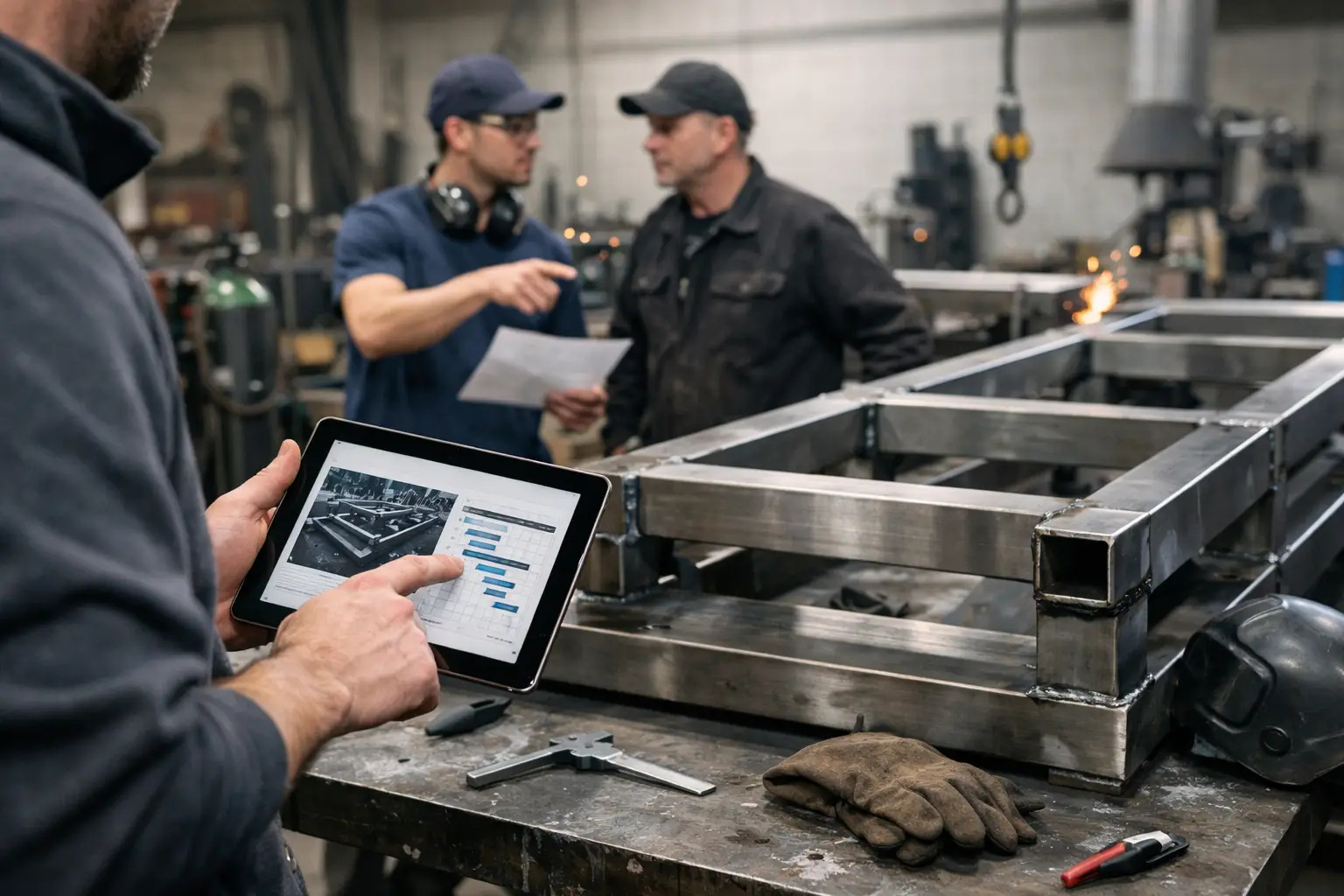
In metal fabrication, visual proof matters even more than polished wording. A quick photo of cut parts, a short video of assembly, or a note showing finished coating often does more than a long explanation. Clients want reassurance that the project is real, active, and under control.
That does not mean every update needs to be detailed. In fact, too much technical language can create confusion. The best client-facing communication translates shop activity into plain business terms. Instead of listing internal production codes or machine details, explain the stage in a way the client can grasp immediately.
A practical structure for metal fabrication progress updates
Most shops do better with a simple repeatable format than with custom-written messages every time. The goal is consistency, not perfect copy.
Start with the stage. Say whether the job is in drawing approval, material receipt, cutting, forming, welding, finishing, assembly, inspection, or shipping preparation. Then show one or two pieces of evidence, usually a photo or short video. Add a brief note about what changed since the last update. Finish with the next expected step and, where possible, the expected timing.
That structure works because it mirrors how clients think. They want to locate the project in time. They want confirmation that something has happened. And they want to know whether the schedule still holds.
It also helps internally. When your team knows that each update follows the same pattern, it becomes easier to gather information without turning the process into admin overhead.
The stages clients usually want to see
Not every fabrication project needs updates at every micro-stage. A simple bracket order does not need the same communication as a bespoke architectural stair, machine frame, or stainless fit-out package. Still, there are a few moments that clients consistently care about.
The first is the kickoff after approval. This confirms the job is live and sets expectations. The second is when materials are in and production is scheduled. The third is the first visible fabrication milestone, such as cutting complete or frame assembly started. The fourth is a major completion point, like welding done or finishing underway. The fifth is final inspection, packing, or dispatch.
If there is a change in scope, lead time, finish, or delivery sequence, that should be its own update. Clients generally accept change better when it is documented clearly and early.
What to avoid in client-facing updates
Some shops make updates too vague. Messages like progressing well or nearly done sound reassuring in the moment, but they create problems later. If the client has no clear idea what nearly done meant, they may feel misled when another week passes.
Others go too technical. A note packed with fabrication terminology may be accurate but still fail as communication. If the client does not understand the significance of what happened, the update does not reduce uncertainty.
The other common mistake is inconsistency. Three updates in one week followed by two weeks of silence trains clients to worry. A lighter but predictable rhythm is usually better than bursts of communication followed by nothing.
Where shops lose control
The biggest communication failures usually come from using tools that were never designed to create a clear client record. Photos live on personal phones. Delivery dates sit in email. A key revision gets approved in a messaging app. Later, a client asks for status, and the team has to search across five places to answer a simple question.
That is manageable on one project. It becomes expensive when you are running ten, twenty, or fifty active jobs.
A better system is one where every project has a single client-facing timeline with visual updates, short notes, stage changes, and key decisions in order. That gives clients visibility without exposing your internal project management or forcing them into contractor software that they do not want to learn.
For teams that handle long-running custom work, that is where a platform like CustomWorks fits naturally. It gives each project a private update feed so photos, videos, notes, changes, and delivery milestones stay in one place the client can follow without chasing your staff.
How often should you send updates?
There is no universal rule, because project complexity changes the right cadence. A fast-turn production run may only need milestone-based updates. A large custom fabrication package with design coordination and staged delivery may need weekly communication even when visible progress is limited.
The right frequency depends on three things: project length, client expectations, and how much uncertainty exists in the current stage. If the job has many approvals, long lead items, or dependencies outside your control, more frequent updates usually help. If the work is straightforward and the timeline is short, fewer but clearer updates are fine.
What matters most is setting the rhythm early. If clients know they will hear from you every Friday or at every major stage change, they are less likely to interrupt the team with ad hoc requests.
Progress updates are part of the product experience
Many fabrication businesses treat communication as an extra task that sits beside production. Clients do not see it that way. For them, communication is part of the service they bought.
That is especially true for custom metal work where the project may be expensive, technical, and built to a unique specification. The client cannot inspect progress on a shelf. They rely on what you show them. Clear updates make the whole project feel more controlled and more professional.
They also protect margins in a less obvious way. Every unnecessary status request pulls someone away from estimating, planning, production, or delivery coordination. If your update process reduces those interruptions, it saves time across the whole business.
Shops do not need perfect reporting. They need a reliable habit. Show the stage, show the work, explain the next step, and keep the record in one place. When clients can see progress clearly, they ask less, trust more, and stay aligned when the project gets complicated.
If your current system still depends on scattered chats and memory, the issue is not just communication style. It is visibility. And in long-running metal fabrication work, visibility is often the difference between a calm client and a nervous one.