Fence Installation Client Updates That Work
A fence project can look simple from the outside, but clients rarely experience it that way. Once the deposit is paid and the crew is scheduled, the questions start. Has materials delivery been confirmed? When will post holes be dug? What happens if rain pushes the install back? Fence installation client updates matter because silence creates uncertainty fast, even on straightforward jobs.
For fence contractors, this problem usually shows up as constant message checking, repeated phone calls, and scattered communication across text, email, and job notes. None of that feels serious on its own, but together it creates friction for the team and doubt for the client. A customer who does not know what is happening will often assume nothing is happening.
CustomWorks.app
Keep clients updated without messy chats
Give each project a private feed for client updates — and keep a clear history of photos, videos, notes, stages, decisions, and delivery moments for your team.
Why fence installation client updates affect more than communication
Most fencing companies think about updates as customer service. That is true, but it is only part of the picture. Good updates also protect scheduling, reduce office workload, and make the business look more organized.
Fence projects often stretch across several stages even when the install itself only takes a few days. There is site measuring, quote approval, material ordering, permitting in some areas, utility marking, removal of old fencing, layout confirmation, post setting, panel or board installation, gate fitting, cleanup, and final sign-off. If the client only hears from the company when something goes wrong, they are left filling in the gaps themselves.
That creates two problems. First, the client starts chasing updates. Second, the team starts answering the same question in different places. One answer goes by text, another by email, and a third over the phone. By the end of the job, there is no clean record of what was shared, when it was shared, or which changes the client approved.
What clients actually want during a fence project
Most clients do not want daily technical reports. They want proof of movement and clarity about what comes next.
That distinction matters. A homeowner waiting on a backyard privacy fence does not need to know every internal scheduling detail. They do want to know that materials are ordered, the start date is still on track, the crew completed the post layout, and weather has pushed staining by two days. For a commercial client, the expectation is similar but usually more structured. They want visible progress, documented changes, and fewer surprises.
Strong fence installation client updates usually include a few consistent elements: stage progress, short notes in plain language, photos from the site, changes that affect scope or timing, and a clear next step. That is enough to answer most status questions before they are even asked.
Where fence installation client updates usually break down
The issue is rarely that teams do not care. It is that updates are handled informally.
A project manager takes a few site photos but forgets to send them. A crew lead tells the office that concrete is curing and gate hardware will be installed tomorrow, but that detail never reaches the client. A customer replies to an old email thread with a question about stain color, while the estimator has already discussed a revision by text message. The information exists, but it is scattered.
This is especially common in fencing because crews are moving fast, working outdoors, and juggling multiple jobs. Updating the client often feels like an extra admin task rather than part of delivery. But when updates are inconsistent, the business pays for it anyway through interruptions and avoidable confusion.
A practical structure for better client updates
The best system is not the most detailed one. It is the one your team will actually use on every project.
For fence work, a simple update structure is usually enough. The first update should confirm the project is active and explain the expected sequence. That alone reduces uncertainty because the client knows what milestones to expect.
After that, each update should answer three things: what happened, what changed if anything, and what happens next. For example, an update might say that materials have arrived, post locations are marked, and installation starts Thursday morning. If rain causes a delay, the update should state the reason, the revised date, and whether the delay affects the rest of the timeline.
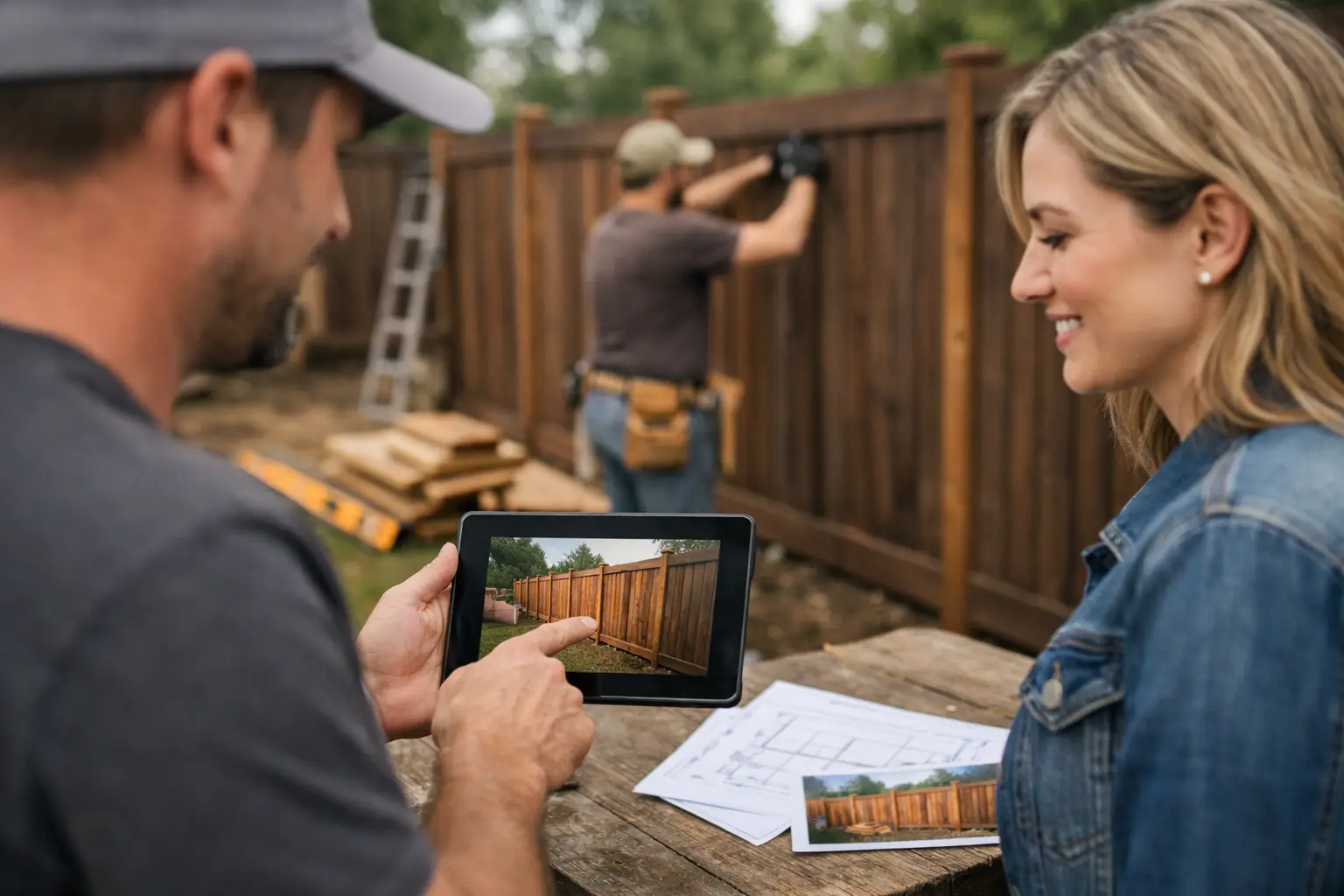
Photos make a major difference here. A picture of marked lines, posts set in concrete, or completed gate hardware gives clients immediate reassurance. It also creates a useful visual record if questions come up later about alignment, access, finish, or site conditions.
What to include at each stage
Not every fence job follows the same pattern, but most projects benefit from updates at key points.
Before work starts, confirm scope, product choice, start window, and any prerequisites such as access clearance or utility marking. This is also the right time to set expectations around possible weather delays and material lead times.
At the start of installation, share that the crew is on site and note what is being completed first. During active work, updates should focus on visible progress, especially when a project runs across multiple days. If there is a client decision needed, such as gate swing direction or a minor layout adjustment, document it clearly and keep it attached to the project history.
Toward the end of the job, updates should shift from progress to completion. Let the client know what has been finished, whether any curing time or settling period applies, and when final walkthrough or sign-off will happen. That final stage matters because many disputes come from assumptions right before handover.
Why one organized timeline beats scattered messages
Text messages feel fast, and email feels familiar, so many fence companies rely on both. The trade-off is that neither creates a clean client-facing project history unless someone spends time manually organizing everything.
A single timeline works better because it keeps updates, photos, notes, and decisions in order. Clients do not have to search through their inbox or scroll through old chats to figure out where the project stands. The team does not have to remember whether a detail was shared by phone, text, or email. Everyone sees the same history.
That is where a platform like CustomWorks fits naturally for long-running custom projects. Instead of treating updates as scattered conversations, it gives each project a private client feed where progress, photos, changes, and delivery moments can be shared in one clear place.
The business impact of clearer updates
Better client communication is not just about being polite. It changes how the company operates.
When updates are consistent, office staff spend less time replying to status requests. Project managers waste less energy repeating the same information. Crews can focus on work instead of stopping to explain what happened yesterday or what is scheduled tomorrow. That time adds up quickly across dozens of active projects.
It also improves trust at the exact point where trust is most fragile. Fence jobs often involve a deposit, visible disruption on the property, and several days where the site looks unfinished. If the client only sees temporary mess without explanation, confidence drops. If they see the same site with clear progress notes and photos, the project feels under control.
There is also a sales benefit. A professional update process signals that the business is structured. For many buyers, especially commercial ones, that matters almost as much as the fence itself.
It depends on the type of fence project
Not every customer needs the same level of communication. A one-day chain-link replacement for a property manager needs fewer updates than a multi-phase perimeter fence with custom gates, access control, and phased scheduling.
That is why the best approach is flexible rather than heavy. The goal is not to flood clients with messages. The goal is to remove uncertainty. Some jobs need a start update, one progress update, and a completion note. Others need more frequent communication because the timeline, scope, or decision points are more complex.
The mistake is treating all updates as optional until a problem appears. By then, the conversation is reactive. A simple structure used from day one keeps communication calm and predictable.
Make updates part of delivery, not an afterthought
Fence companies that handle updates well usually do one thing differently: they build communication into the job process itself. Taking site photos, posting a short note after each milestone, and recording changes as they happen becomes part of how the project is delivered.
That approach is more reliable than depending on memory at the end of a long day. It is also easier to delegate. A crew lead can capture progress. A project manager can review exceptions. The client gets a steady flow of useful information without chasing anyone.
Silence is what creates most update problems in fence installation. A clear, visible record of progress solves more than it seems to at first. It lowers friction, protects trust, and gives clients a much better experience while the work is still in progress.