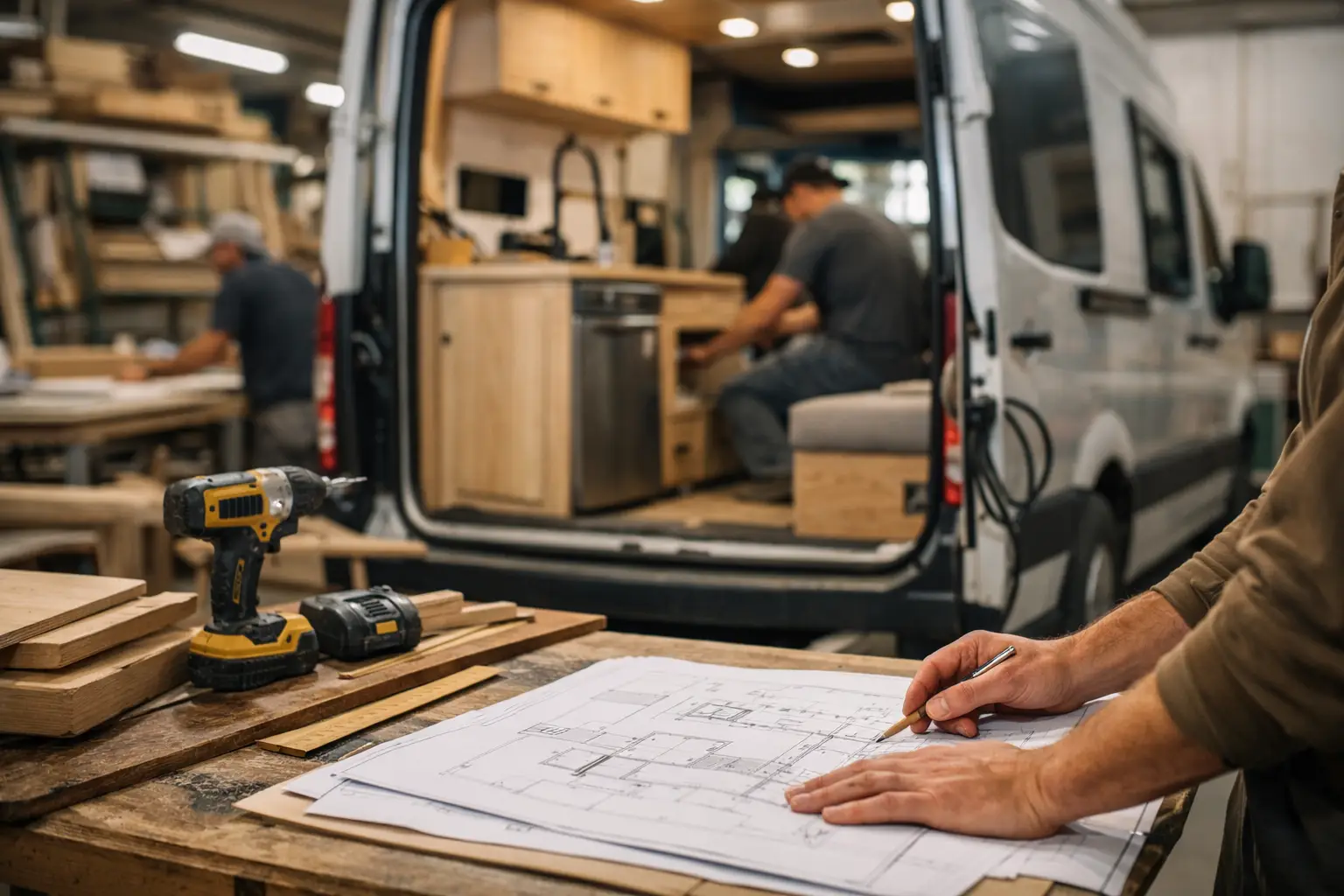
Camper Van Conversion Project Updates That Work
A camper van build can look quiet from the client side even when the workshop is moving fast. One week is insulation and wiring behind closed panels, the next is waiting on a part, and then suddenly the interior starts taking shape. That gap between real progress and visible progress is exactly why camper van conversion project updates matter.
For van conversion companies, the problem is rarely the work itself. It is the communication around the work. Clients have often paid a large deposit, handed over a valuable vehicle, and committed to a timeline that can stretch for weeks or months. If they do not see what is happening, they start filling in the blanks themselves. That usually leads to anxious messages, repeated calls, and long email threads asking for the same reassurance in different ways.
CustomWorks.app
Keep clients updated without messy chats
Give each project a private feed for client updates — and keep a clear history of photos, videos, notes, stages, decisions, and delivery moments for your team.
The businesses that handle this well do not necessarily send more communication. They send clearer communication. They make progress visible, explain what changed, and give clients one place to follow the build without chasing the team.
Why camper van conversion project updates matter so much
A van conversion is personal. Clients are not just buying labor and materials. They are buying a vehicle that may become a travel home, a full-time living space, or a business asset. That raises the stakes of every delay, design decision, and build stage.
From the workshop side, this creates pressure. Teams are trying to manage fabrication, electrical work, plumbing, cabinetry, upholstery, supplier lead times, and client choices at the same time. If communication is scattered across text messages, shared photo albums, and email threads, the client experience starts to feel less organized than the actual build.
That disconnect hurts trust. Even when the project is on track, silence can make it feel uncertain. A simple update with a few photos of cable routing, insulation, subfloor prep, or cabinet fitting can do more to reassure a client than a vague message saying the team is making progress.
There is also a practical reason to get this right. When clients can clearly see what stage the project is in, they ask fewer reactive questions. Instead of sending “Any updates?” messages every few days, they can follow the build as it develops. That saves time for the team and keeps communication more professional.
What good project updates actually look like
The best camper van conversion project updates are not polished marketing content. They are simple, timely, and specific enough to answer the client’s next question before it gets asked.
A useful update usually combines three things: a visual, a short explanation, and context. The visual could be a few workshop photos or a quick video walkaround. The explanation says what has been completed. The context explains where that work sits in the bigger timeline.
For example, a photo of framed wall sections is helpful. A photo plus a short note saying the framing is complete, wiring routes are confirmed, and insulation starts next is much better. It turns an image into a milestone.
This matters because not every stage looks impressive. Early work often looks messy to an untrained client. Exposed wiring, bare timber battens, sealant lines, cutouts, and test-fitted components can look unfinished or even wrong without explanation. A good update removes that uncertainty.
The stages clients most want to see
Not every part of a van conversion needs the same level of detail, but some points in the build naturally carry more client interest. The handover of the vehicle, strip-out, structural prep, insulation, first-fix electrical and plumbing, paneling, furniture installation, finish details, testing, and pre-delivery checks are usually the moments clients care about most.
That does not mean every update needs to be long. In fact, shorter is often better. A client who can scroll through a clear timeline of photos, short notes, stage changes, and key decisions usually feels more informed than one who receives occasional long email updates with too much detail buried inside.
There is also a trade-off here. Too few updates create anxiety. Too many low-value updates create noise. If every post says roughly the same thing, clients stop paying attention. The goal is not constant activity. The goal is visible progress.
Where communication usually breaks down
Most van conversion businesses do not set out to create a messy update process. It usually happens gradually.
A client asks for a quick photo on WhatsApp. A team member sends one from the workshop floor. Another decision gets confirmed by email. A delivery delay gets mentioned in a phone call. Later, someone needs to check what finish was approved, when the solar setup changed, or whether the client had seen the revised bed layout. Now the information exists, but the history is fragmented.
This creates two problems. First, the team loses time reconstructing conversations. Second, the client experience feels inconsistent. Some clients get instant replies, others wait. Some decisions are documented clearly, others live inside chat threads no one wants to search.
On long-running custom projects, that is where communication starts to feel reactive instead of controlled.
A better way to handle camper van conversion project updates
A stronger approach is to treat updates as part of project delivery, not as an extra task that happens when someone finds a spare minute. That means having one client-facing place where progress is documented in order and where each update contributes to a clear visual history of the build.
For a van conversion company, this can be very simple. When a meaningful stage is completed, the team uploads a few photos or a short video, adds a short note, and marks what changed or what comes next. If a client decision affects the build, that can be added in the same timeline. If there is a delay, it can be explained once, clearly, in context.
This kind of structure changes the tone of the relationship. Instead of clients having to request proof that the build is moving, the business is already providing it. Instead of scattered messages, there is one organized record. Instead of repeating the same status explanation to different stakeholders, the company can present a consistent project view.
That is the logic behind platforms like CustomWorks, which are built specifically for client project updates rather than internal task management. For businesses delivering long-running custom work, the value is not complexity. It is having a simple, private feed that keeps clients informed without creating more admin.
What to include in each update
The easiest way to improve update quality is to standardize the content slightly. Not with a heavy template, but with a simple rhythm.
Show what was done. Explain why it matters. Mention what is next.
That could be as straightforward as posting three workshop photos and adding a note that the diesel heater has been installed, duct runs are complete, and the next stage is cabinet fitting after the electrical check. In one post, the client sees tangible progress, understands the purpose of the work, and gets a realistic sense of what happens next.
When a project hits a snag, the same format still works. If a window supplier delays delivery or a layout change affects fabrication, the client usually handles the news better when it is communicated early and clearly. Silence is what tends to create frustration, not the existence of a problem itself.
Why this matters beyond client satisfaction
There is a direct operational upside to organized updates. Teams spend less time answering duplicate questions. Managers have a cleaner record of what was shared and when. Photos, decisions, and change moments are easier to find later. If there is ever confusion about scope, finish choices, or handover readiness, the project history helps ground the conversation in facts.
It also raises the perceived professionalism of the business. A workshop may do excellent work, but if the communication feels improvised, clients often judge the whole operation as less reliable. On the other hand, a clear update process makes the company feel structured, transparent, and in control.
That matters for referrals too. Clients talk about the experience of the build, not just the final van. If they felt informed throughout, that becomes part of the value they remember.
Start simple, but make it consistent
If your current process relies on texts, phone calls, and the occasional emailed photo batch, you do not need to transform everything overnight. The first improvement is simply choosing one format for client-visible updates and using it consistently across projects.
A weekly update cadence can work well for some builders. Others may prefer stage-based updates tied to real build milestones. It depends on project length, client expectations, and how much visible change happens from week to week. What matters most is that the client knows where to look and what kind of communication to expect.
Once that becomes routine, communication gets easier for everyone. Clients stop wondering whether they need to chase. Teams stop repeating themselves across channels. The build feels more tangible because progress is documented as it happens.
For camper van conversion companies, that is not just a communication upgrade. It is a better way to deliver the whole project experience. When the work is custom, high value, and spread over time, visibility is part of the product.