Client Updates for Outdoor Living Contractors
A patio build can look quiet for three days and then change dramatically in one afternoon. A client standing in their backyard usually does not see the difference between waiting on pavers, curing concrete, a permit delay, and no activity at all. That is why client updates for outdoor living contractors matter so much. When communication is unclear, clients fill the gap themselves, and usually not in your favor.
Outdoor living projects create a specific kind of pressure. They are highly visible, often expensive, and tied to emotion. The client is not buying a hidden system behind drywall. They are buying the space where they plan to host friends, cook outdoors, relax with family, or improve the value of their home. Once a deposit is paid and work starts, silence feels risky.
CustomWorks.app
Keep clients updated without messy chats
Give each project a private feed for client updates — and keep a clear history of photos, videos, notes, stages, decisions, and delivery moments for your team.
For contractors, that silence usually has a cost. It shows up as repeated texts asking for timelines, phone calls during site visits, long email threads about choices that were already discussed, and photos scattered across team phones. None of this means the client is difficult. Most of the time, they just want proof that the job is moving and that their project has not drifted into the background.
Why outdoor living projects need better client updates
Outdoor living work tends to run across multiple stages, and many of those stages are not obvious to the client. Design approval, material ordering, demolition, drainage prep, electrical rough-in, base work, framing, installation, finish details, punch items – each part affects the next. If the client only sees the finished pergola or completed outdoor kitchen, they miss the fact that real progress often happens below the surface.
Weather makes this harder. A rain delay feels understandable to a contractor and frustrating to a homeowner. A delayed stone delivery sounds ordinary to your team and alarming to the person who already moved a family event back by two weeks. Good updates help translate job reality into something clients can follow.
There is also the question of professionalism. Outdoor living contractors often operate in a competitive local market where referrals matter. Clients compare not only craftsmanship, but also communication. A company that keeps people informed tends to feel more organized, more reliable, and easier to trust when changes happen.
What clients actually want to know
Most clients do not need a full project management dashboard. They do not want to sort through internal tasks, supplier notes, or crew scheduling. They want a clear answer to a few practical questions.
What happened this week? What is happening next? Has anything changed? Do I need to approve something? Are we still on track?
That is the standard. If your update process answers those questions consistently, client communication becomes much easier. If it does not, clients will ask in their own way, through texts, calls, and follow-up messages that interrupt your day.
This is where many teams overcomplicate things. They think client communication has to mean polished reports or long written explanations. In practice, a photo of installed footings, a short note about the next stage, and a clear mention of one weather delay can do more than a carefully worded weekly email no one reads closely.
The best format for client updates for outdoor living contractors
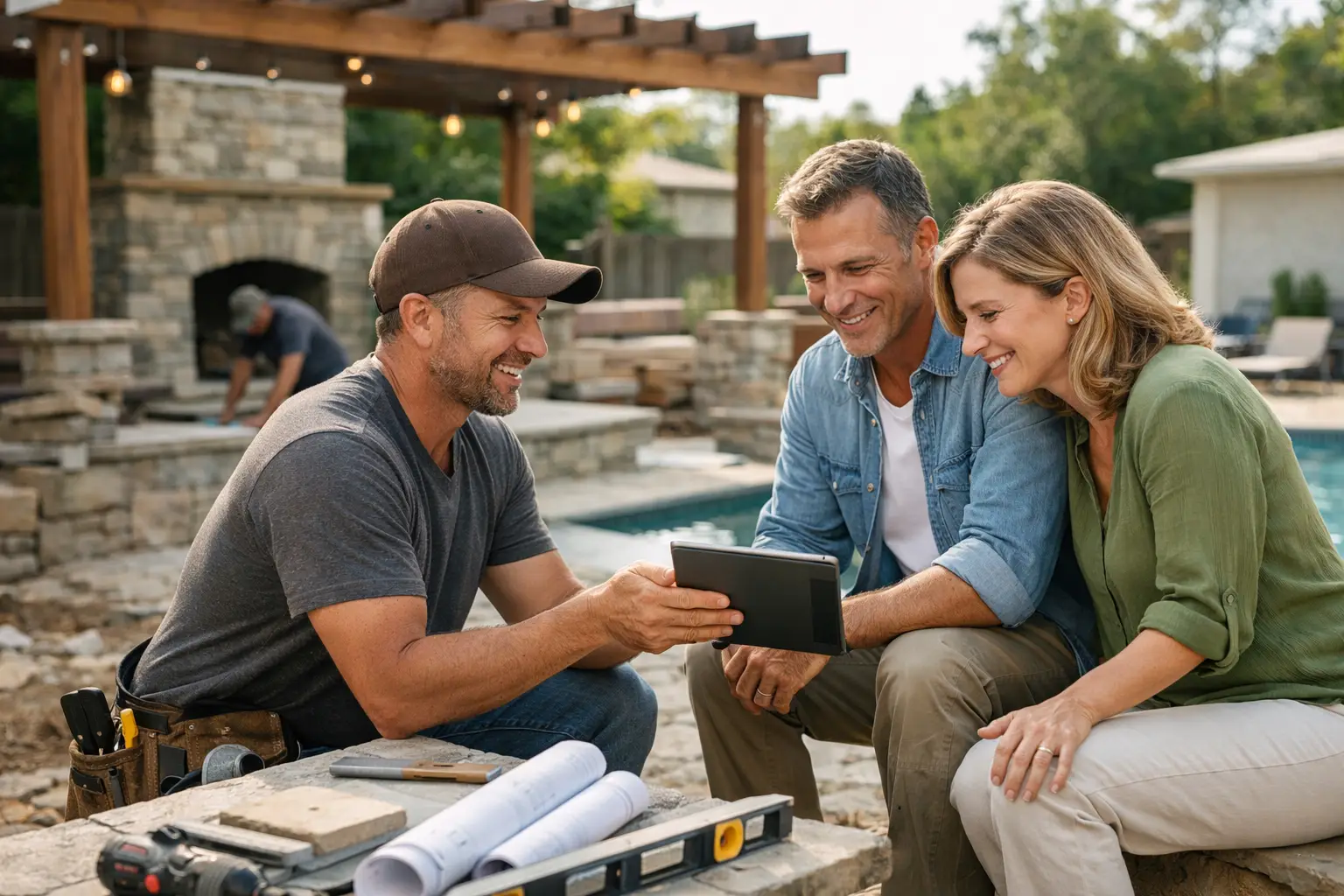
The strongest approach is usually a simple, visual project timeline. Outdoor projects are easy to understand visually. Clients respond well to before-and-after progress, in-progress site photos, short videos, marked stages, approval notes, and visible records of changes.
A timeline works because it gives structure without creating extra admin. Instead of searching old texts for the tile selection photo or scrolling through email to confirm when the fire feature was approved, both your team and the client can see a clean history of the job in order.
That matters more than many contractors expect. A visual record reduces confusion around scope changes, design decisions, and delivery timing. It also lowers the chance that one team member knows something another person forgot to pass on.
For outdoor living contractors, the most useful updates usually include progress photos, short notes from site, material arrival updates, weather-related schedule changes, completed stages, client-facing decisions, and handover milestones. That is enough to create clarity without turning updates into a second job.
Where communication usually breaks down
The common problem is not a total lack of communication. It is fragmented communication.
One project update is sent by text. Another is shared in email. Photos are stored on a supervisor’s phone. A client approves a finish in WhatsApp. Someone in the office sends an invoice note that references a change the client has not seen yet. Every message makes sense on its own, but together they create a messy client experience.
This is especially risky on long-running outdoor projects with multiple moving parts. A pool surround, covered patio, outdoor kitchen, retaining wall, lighting package, and landscaping phase may all overlap. When updates live in different places, details get lost and clients start asking for reassurance more often.
The trade-off is straightforward. Informal messaging feels quick at first, but it becomes harder to manage as project value and duration increase. A more structured update process takes a little discipline, but it saves time once the project is underway.
How to make updates useful without creating extra admin
Good client updates should be brief, regular, and specific. They do not need to be long. In fact, shorter is often better if the information is clear.
A practical rhythm might be two to three updates per week during active site work, plus an update whenever a key decision, delay, or visible milestone occurs. If nothing major happened, that is still worth saying. A short note explaining that rain pushed masonry work to Thursday is better than leaving the client to guess.
Photos do most of the work. A few well-chosen images from site can explain excavation progress, framing completion, utility prep, or finish installation faster than paragraphs of text. Add one or two sentences that explain what changed and what comes next.
It also helps to label stages in client language, not internal shorthand. “Drainage base completed” is clearer than a crew-specific abbreviation. “Waiting for grill unit delivery before countertop template” is better than a vague note that says “pending supplier.”
The goal is not to share everything. The goal is to share the right things in a format that lowers uncertainty.
A simple process that works on real projects
Start by defining what your clients should see every time. For most outdoor living contractors, that means visible progress, next step, any timing change, and any client action needed. Once that structure is fixed, updates become easier to produce because your team is not reinventing the format for each project.
Then assign ownership. If nobody owns client updates, they become inconsistent. The owner might be a project manager, office coordinator, site lead, or business owner depending on team size. What matters is that one person is responsible for making sure updates happen.
Next, capture updates as work happens. Waiting until Friday evening to reconstruct the week from memory is where details get missed. A better system is to collect photos, quick notes, and stage changes in real time, then publish them in a client-friendly format.
This is one reason some contractors use a tool like CustomWorks – it gives each project a private update feed where photos, videos, notes, stages, changes, and delivery milestones stay in one clear timeline. That setup fits outdoor living work well because the client can see visible progress without being dragged into internal project management.
What better updates change for your business
The first result is fewer interruptions. When clients can already see that the pergola posts are in, the outdoor kitchen appliances are delayed, and countertop install is booked for next week, they are less likely to send another status message.
The second result is stronger trust during slow or awkward phases. Every contractor knows that some of the most stressful moments for clients happen when a site looks unfinished, muddy, or temporarily worse than before. Clear updates give context to those moments and help clients stay confident in the process.
The third result is a cleaner project record. That becomes valuable when there is a dispute over timing, a question about when a change was approved, or a need to review the sequence of work after completion. A visible communication history protects both sides.
It can also improve referrals. Clients rarely recommend a contractor based only on the final build. They recommend the full experience. If they felt informed throughout the project, they are much more likely to describe your company as organized and easy to work with.
Client updates for outdoor living contractors are not just courtesy
They are part of delivery. On a high-value custom project, communication is part of what the client is buying. Not because they want to micromanage the job, but because they want confidence that the work is progressing, decisions are being tracked, and someone is in control.
That does not mean sending constant messages. Too many updates can be as unhelpful as too few. The right amount depends on project size, complexity, and client expectations. A compact deck replacement may need far less communication than a multi-phase backyard transformation with hardscape, lighting, drainage, and cabinetry.
The useful standard is simple: if a client can understand where the project stands without chasing your team, your update process is probably working.
And if they cannot, the problem is usually not the client. It is the system.