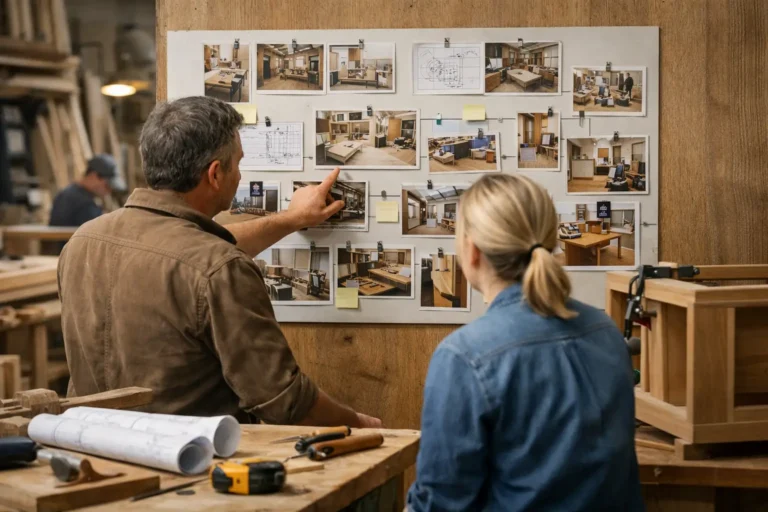
Private Project Feed for Fit-Out Companies
Fit-out clients rarely complain about too much communication. They complain about silence, mixed messages, and not knowing whether the job is moving forward. A private project feed for fit-out companies solves that problem in a way email chains, WhatsApp groups, and scattered photo uploads usually do not.
For fit-out teams, the issue is not just sending updates. It is keeping updates organized across projects that run for weeks or months, often with multiple stages, approvals, site constraints, supplier changes, and client questions. When communication lives across inboxes, chat threads, and camera rolls, the client experience starts to feel messy even if the work itself is solid.
CustomWorks.app
Keep clients updated without messy chats
Give each project a private feed for client updates — and keep a clear history of photos, videos, notes, stages, decisions, and delivery moments for your team.
A private feed gives each project its own client-facing timeline. Instead of sending one-off messages, your team posts progress as it happens – photos from site, short videos, stage updates, notes about completed work, decisions that were made, changes that affect delivery, and handover milestones. The client sees one clear record of progress without needing access to your internal systems.
Why fit-out projects need a private project feed
Fit-out work creates a specific communication problem. Clients usually pay significant deposits, expect visible movement, and often have commercial deadlines tied to the space opening. Even when the project is under control internally, the client can feel uneasy if they do not see evidence of progress.
That tension gets worse when there are many moving parts. A retail fit-out, office refurbishment, hospitality install, or specialist interior package may involve demolition, first fix, fabrication, finishes, snagging, deliveries, and coordination with other trades. In practice, updates happen in fragments. A supervisor takes photos on site. A project manager sends a quick note by email. A client asks for a change on messaging. Later, nobody has one complete history.
A private project feed creates that history as the project unfolds. It is less about reporting for reporting’s sake and more about giving the client confidence that the job is active, documented, and managed.
What a private project feed for fit-out companies actually does
At its simplest, it replaces scattered status communication with one structured timeline per project. The client does not need to search old emails for photos, scroll through chat threads for approvals, or ask your team to resend the latest update. Everything relevant sits in one place.
That matters because most client questions are not really asking for technical detail. They are asking, “Is the project moving?” and “Can I trust what is happening?” A feed answers both with visible proof.
In a fit-out context, useful updates usually include progress photos, short walkthrough videos, notes on completed stages, changes to scope, material arrivals, key decisions, and practical delivery updates. This is not full project management. It is client communication with structure.
That distinction matters. Internal tools are often too detailed, too technical, or too cluttered for clients. A private feed keeps the client informed without exposing every internal dependency, task, or operational discussion.
The business problem it helps solve
Most fit-out companies do not lose time because updates are impossible. They lose time because updates are repeated, inconsistent, and buried across channels.
A client asks for an update on Tuesday. Your team replies with a few photos. On Friday, another stakeholder asks what has been completed. Someone forwards an old email, adds context, and attaches different images. The following week, there is a question about when partitioning was finished or when the flooring issue was flagged. Now the team is reconstructing a timeline from memory.
That creates avoidable friction in three places.
First, it drains project managers and office teams with repetitive status requests. Second, it increases the chance of miscommunication because different people are working from different message histories. Third, it weakens the professional impression of the business. Even strong delivery can look disorganized when communication feels improvised.
A private project feed reduces that pressure by making project visibility part of the process, not a reaction to incoming questions.
Where email and chat fall short
Email still has a role, especially for formal approvals and commercial paperwork. Chat is useful for speed. But neither is a good long-term home for project visibility.
Email is hard to scan over a three-month fit-out. Attachments get buried, replies split into side conversations, and not every stakeholder sees the same thread. Chat is even more fragile. Important images disappear into daily noise, details get mixed with quick questions, and decisions are difficult to find later.
A private feed works better because it is chronological, visual, and project-specific. It gives clients one destination for progress rather than expecting them to piece the story together themselves.
What good client-facing updates look like
The best updates are short, visual, and specific. A fit-out client does not need a wall of text every time someone completes a stage. They need enough context to understand what changed.
A strong post might show site photos and explain that ceiling grid installation is complete in the front-of-house area, MEP coordination is finished in the rear section, and joinery delivery is expected next week. Another might include a short video walkthrough with notes on lighting installation and pending signage confirmation.
This style of update does two things at once. It reassures the client that work is progressing, and it creates a clean project record that your own team can refer back to later.
There is a trade-off, though. Too many updates can create noise, while too few can recreate the original problem. The right rhythm depends on project length, client expectations, and how visible the progress is. A fast retail refresh may need frequent visual updates. A longer office fit-out may benefit from milestone-based communication with occasional interim posts.
Why this matters for trust after deposit and before handover
Fit-out companies often operate in the most trust-sensitive phase of a client relationship. The client has committed budget, the work is underway, and the result is not yet visible in full. That is when silence feels most expensive.
If a client does not hear from you, they tend to fill the gap with their own assumptions. They may assume delays, lack of coordination, or low priority, even when none of that is true. A private feed prevents that vacuum.
It also helps during difficult moments. If there is a change in sequencing, a supply issue, or a decision that affects timing, it is easier to communicate clearly when the project already has an established update history. Clients are more likely to accept a bump in the road when they can see consistent evidence of progress before and after it.
A practical way to start using a private project feed
The easiest rollout is usually simple. Pick active projects where clients already ask for updates regularly. Decide who posts, what gets posted, and how often. In many fit-out businesses, that means site leads capture photos, project managers add brief context, and the client receives a clear timeline without joining your internal tools.
Keep the format tight. Post visuals, short notes, stage markers, and decision points. Do not try to turn the feed into a technical report. Its job is visibility.
If your current process is built around chat apps and inboxes, the immediate benefit is clarity. Teams stop rewriting the same update for different people. Clients stop chasing basic status. The project starts to feel organized from the outside, which matters more than many companies realize.
For businesses that want a dedicated system for this kind of client communication, CustomWorks is built around private project feeds, visual updates, and clear project history for long-running custom jobs.
The fit-out companies that benefit most
This approach works especially well for companies handling commercial interiors, office fit-outs, retail rollouts, hospitality refurbishments, healthcare spaces, branded environments, and specialist installation packages. These projects tend to involve visible progress, frequent client interest, and enough complexity that scattered communication quickly becomes a problem.
It is also useful for smaller teams. In fact, smaller firms often see the fastest value because they feel the communication burden more directly. When one project manager is juggling site coordination, client calls, procurement questions, and reporting, reducing repeated update requests has a real operational effect.
A private project feed will not fix bad scheduling, poor delivery, or unclear scope. But it does fix a common gap between doing the work and showing the work. For fit-out companies, that gap is often where unnecessary friction starts.
Clients do not expect perfection on every project. They do expect to see that their project is active, documented, and being handled professionally. When that visibility is built into the job, trust gets easier to maintain and communication gets easier to manage.
The most useful systems are often the ones that remove noise rather than add more process. For fit-out companies, a clear private feed can do exactly that.