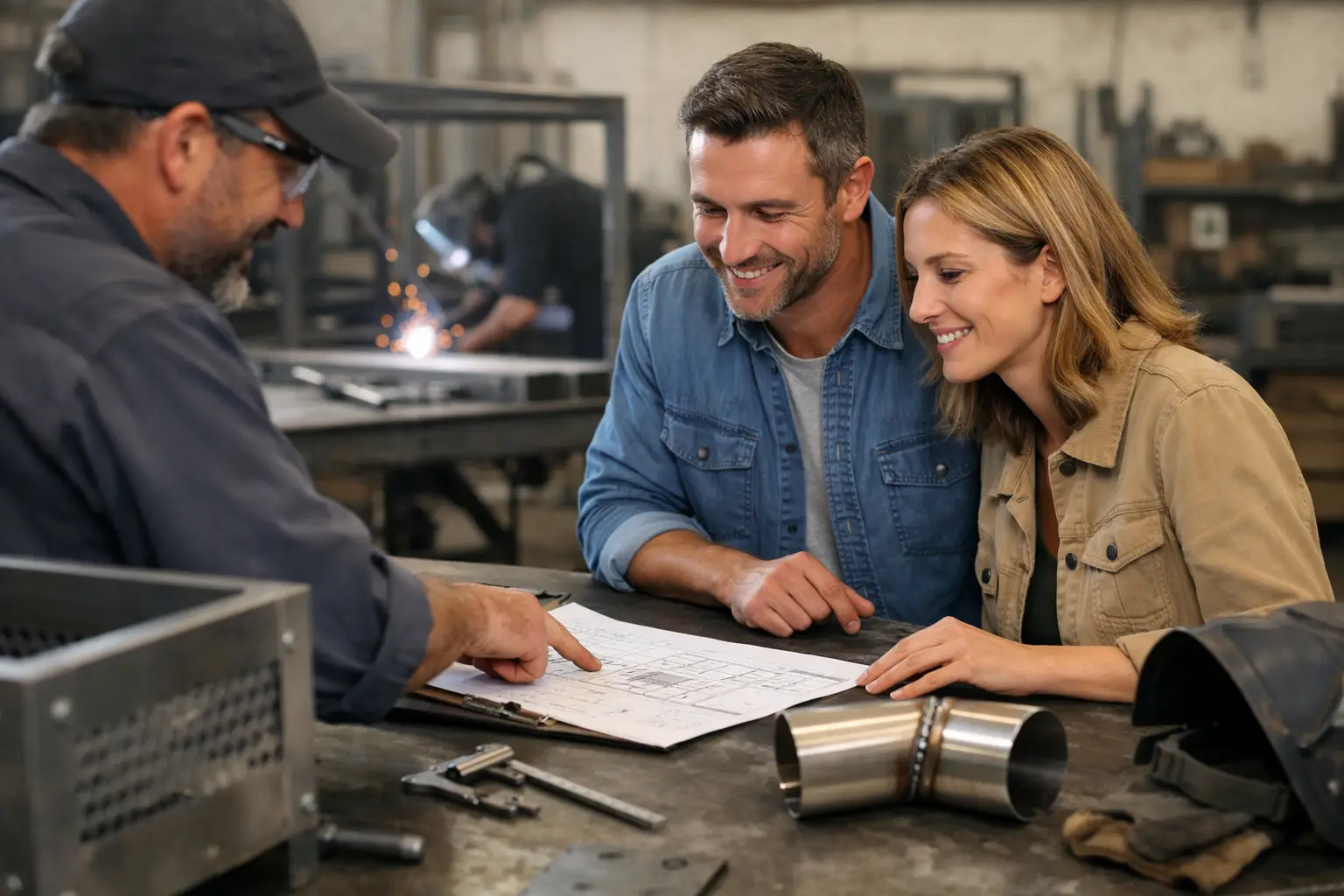
Client-Facing Updates for Metal Fabricators
A fabrication job can be on schedule, within spec, and moving exactly as planned – while the client still feels uneasy. That gap usually has nothing to do with the quality of the work. It comes from silence. Client-facing updates for metal fabricators solve a communication problem that shows up in almost every custom project: the customer cannot see progress, so they start asking for reassurance.
For shops handling structural steel, architectural metalwork, custom assemblies, railings, enclosures, machine parts, or one-off production runs, that pattern is familiar. The work stretches over days or weeks. Materials are ordered, drawings are approved, cutting starts, fit-up changes, welding progresses, finishes are applied, and delivery gets coordinated. Internally, that sequence makes sense. Externally, the client often sees only two moments – the deposit and the final handoff. Everything in between feels like a black box.
CustomWorks.app
Keep clients updated without messy chats
Give each project a private feed for client updates — and keep a clear history of photos, videos, notes, stages, decisions, and delivery moments for your team.
That black box creates avoidable friction. Clients send follow-up emails. They text for photos. They ask whether the project is still on track. Team members reply from their phones, forward messages, dig through old images, and repeat the same information in slightly different ways. None of that improves fabrication. It just adds noise.
Why metal fabrication clients ask for updates so often
Most clients are not trying to micromanage your shop. They are trying to reduce risk on their side. If they have ordered a custom staircase, storefront frame, industrial platform, or specialized component, your work is usually tied to another deadline. Installation teams may be waiting. Other trades may be blocked. Site access may be booked. A missing update from your shop can create uncertainty far beyond the fabrication itself.
That is especially true when the project includes design changes, long lead materials, finishing stages, or staged delivery. A customer who paid a large deposit wants proof that momentum is real. Even a short visual update can do that. Without it, they fill the silence with assumptions.
There is also a credibility issue. Fabricators often do excellent work but communicate progress in a way that feels improvised. Photos sit in personal phones. Change approvals live in text threads. Delivery notes get buried in email chains. From the client perspective, that can make a capable shop look less organized than it really is.
What good client-facing updates for metal fabricators actually look like
Good updates are not long reports. They are short, factual, visual, and easy to follow over time. The goal is not to overwhelm the client with shop detail. The goal is to make progress visible.
In practice, that usually means posting a clear update when a meaningful stage is completed. For example, the client might see that drawings are approved, material has arrived, cutting is complete, weld assembly is underway, surface prep is finished, powder coating is booked, or delivery has been scheduled. A photo or short video often does more than a paragraph of explanation.
The strongest updates also capture decisions and changes while they happen. If a bracket location changed, if a finish sample was selected, or if a site measurement led to a small adjustment, that should not live only in a private message somewhere. It should sit in a client-visible project history where everyone can refer back to it.
This is where many shops go wrong. They think updates mean writing more. Usually, it means organizing better. A simple timeline of photos, notes, milestones, and approvals is far more useful than polished but infrequent communication.
The business case for a client update process
When owners think about communication, they often focus on customer service. That matters, but there is also a direct operational benefit. A clear update process reduces interruptions.
If clients know where to look for progress, they ask fewer one-off questions. If photos and notes are stored in one place, the team spends less time hunting for context. If decisions are recorded as they happen, disputes become easier to resolve. The result is not just a happier client. It is a calmer project.
There is a sales effect too. Custom fabrication often depends on trust before the finished product exists. A shop that communicates cleanly during production looks more reliable, more professional, and easier to work with. That matters for repeat business and referrals, especially in markets where buyers compare not only craftsmanship but also the experience of working together.
There is a trade-off, of course. Updates take time. If the process becomes too detailed, it turns into admin work that no one maintains. That is why the best system is usually light. A few useful updates at the right moments beat daily messages that add little value.
Where fabricators usually lose control of communication
The common problem is not a total lack of communication. It is fragmented communication. One project has progress photos in WhatsApp, approvals in email, delivery changes in a call log, and site notes in someone’s memory. When a client asks for a status update, the team has to reconstruct the story from scattered pieces.
That gets harder when multiple people touch the project. Sales promises one date, production gives another estimate, installation has its own dependencies, and the client receives mixed signals. Even when everyone is acting in good faith, inconsistent updates create confusion.
For fabrication businesses running several active jobs at once, this becomes a scaling problem. What feels manageable at five projects becomes messy at twenty. Clients do not experience your internal effort. They experience clarity or the lack of it.
A practical way to structure updates without adding bureaucracy
The simplest approach is to define a small number of update moments that apply to most jobs. That could include kickoff, materials received, production started, major fabrication stage complete, finish stage, ready for delivery, and completed installation or handoff. Not every project needs every step, but most can fit a version of that structure.
Then decide what each update should include. Usually that is one image or video, a short note in plain language, and any key decision or change that affects timing, scope, or delivery. Keep the language client-friendly. The client does not need every technical detail of the process. They need enough context to understand what has happened and what comes next.
It also helps to assign ownership. If everyone is responsible, nobody is responsible. In some shops, the project manager posts updates. In smaller teams, it may be the owner, estimator, or office lead collecting content from the floor. The exact role matters less than consistency.
For businesses that want a cleaner method than email chains and chat apps, a platform like CustomWorks gives each project a private client update feed with photos, videos, notes, stage changes, and delivery visibility in one timeline. That model fits fabrication work well because it keeps communication client-facing without forcing clients into full project management software.
What to include in client-facing updates for metal fabricators
The best content is usually already happening in your shop. It just needs to be captured at the right time. A cut layout on the table, a completed weldment, a trial fit, a finish sample, packaged components ready for dispatch, or a short clip from the shop floor can all reassure the client that the project is moving.
It is also worth documenting the less visible but commercially important moments. Material delays, revised dimensions, approval requests, and delivery coordination should not be treated as side conversations. If they affect the project, they belong in the record.
That said, not every internal detail should be client-facing. You still need judgment. A failed first pass, internal rework, or staffing issue may not belong in the external feed unless it changes timeline or outcome. Transparency matters, but so does relevance. Good client communication is clear, not indiscriminate.
Why visual progress matters more in fabrication
Metal fabrication is tactile. Clients respond well when they can see raw stock become parts, parts become assemblies, and assemblies move toward finishing and delivery. That visual progression is one of your strongest trust-building tools.
It also helps non-technical buyers understand value. A client may not appreciate the complexity of jigging, tolerances, weld sequencing, or surface prep unless they can see the work taking shape. Visual updates make skilled labor more visible, which often makes timelines and pricing easier to accept.
For architectural and custom work especially, visuals reduce surprises. A progress photo can reveal scale, finish character, or assembly readiness long before delivery day. That creates a chance to correct expectations early rather than manage disappointment later.
The shops that benefit most from a better update system
Almost any fabrication business can improve client communication, but the payoff is highest when projects are custom, high-value, or long-running. If your work involves approvals, changes, staged production, site coordination, or a long gap between deposit and delivery, structured updates can remove a lot of avoidable pressure.
This applies to structural fabrication, decorative and architectural metalwork, stainless and food-grade builds, custom furniture frames, marine and industrial components, and specialist one-off jobs. The more bespoke the work, the more clients want visible proof that progress is real.
A better update process will not fix pricing mistakes, poor scheduling, or production bottlenecks. But it will make a well-run shop feel well-run from the client’s side too. That matters more than many fabricators realize.
Silence makes even strong projects feel uncertain. A steady stream of clear, visual updates makes the work feel controlled, and that is often what clients are really asking for when they say, “Any updates?”