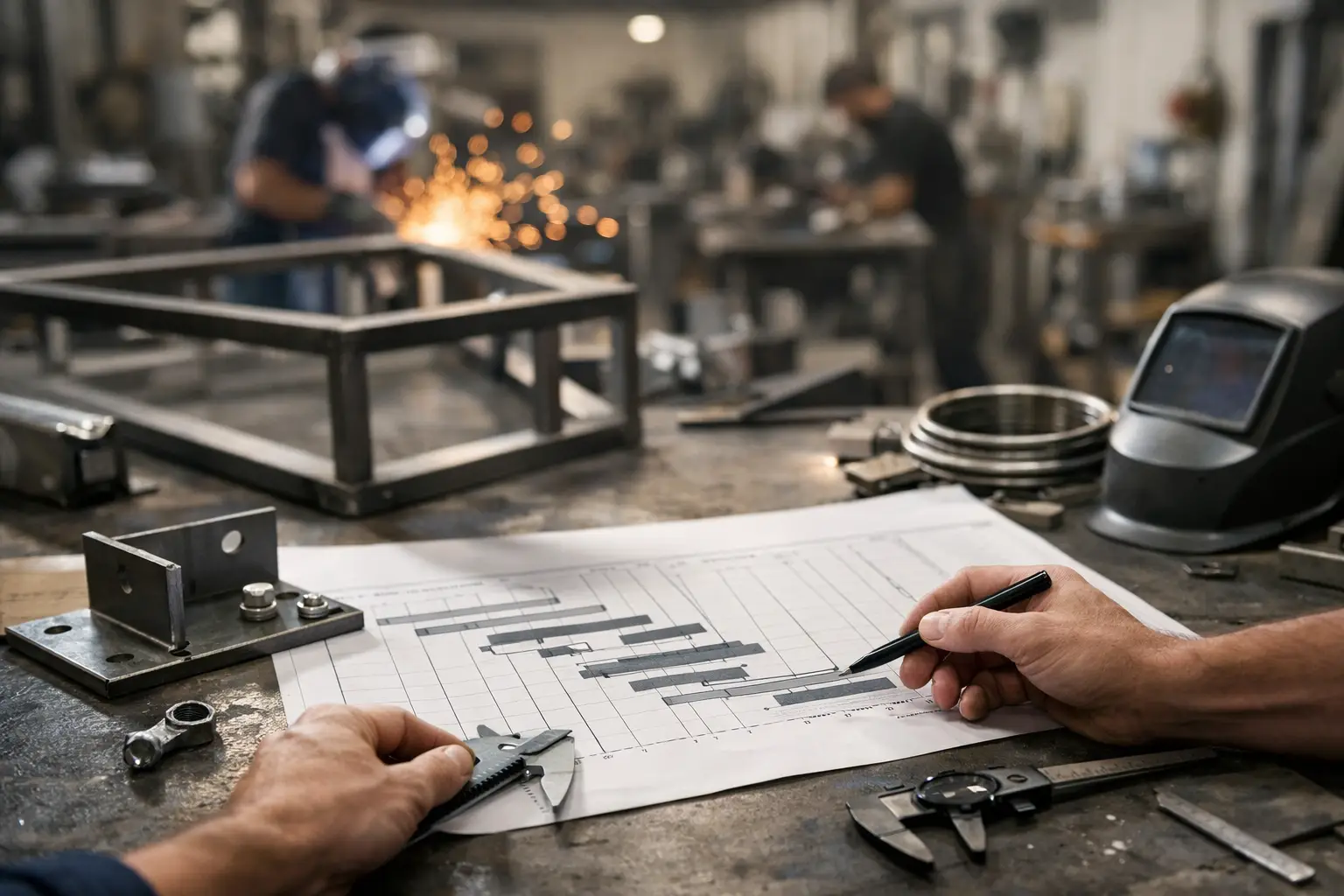
Custom Metalwork Project Timeline Explained
A client approves the design, pays the deposit, and then the waiting starts. For metalwork shops, that gap between kickoff and delivery is where trust is often won or lost. A custom metalwork project timeline is not just a production schedule. It is the story a client experiences while their staircase, gates, railings, cabinetry, architectural feature, or fabricated structure moves from idea to finished install.
That matters because custom metalwork rarely moves in a straight line. Materials shift. Drawings need revisions. Site conditions change. Powder coating slots get pushed. Install dates depend on other trades. From the shop side, all of that is normal. From the client side, silence feels like drift.
CustomWorks.app
Keep clients updated without messy chats
Give each project a private feed for client updates — and keep a clear history of photos, videos, notes, stages, decisions, and delivery moments for your team.
For companies delivering custom metal projects, the real challenge is not only building accurately. It is making progress visible in a way that feels organized and professional.
What a custom metalwork project timeline usually includes
Most custom metal projects move through a familiar sequence, even if the details vary by job size and complexity. First comes scope definition, quoting, and approval. Then design development starts, which may include site measurements, concept sketches, shop drawings, finish decisions, engineering review, or compliance checks depending on the project.
After that, the work enters pre-production. Materials are ordered, shop capacity is scheduled, and dependencies are lined up. Fabrication follows, but fabrication itself may involve several stages rather than one continuous block of work. Cutting, forming, welding, grinding, trial assembly, finishing prep, coating, and final quality checks often happen in waves.
The last phase is usually delivery or installation, followed by any punch-list corrections or sign-off. On paper, that sounds clean. In practice, each phase has decision points that can extend or compress the timeline.
Why custom metalwork timelines often feel longer than expected
Clients tend to think in calendar dates. Shops tend to think in production reality. The difference between those two views is where friction starts.
A metal fabrication business may say a job takes eight weeks, but those eight weeks are rarely eight weeks of uninterrupted hands-on work. There may be waiting periods for supplier deliveries, finish samples, engineering approval, site readiness, or access for install. If another trade is delayed, metalwork may be finished in the shop but unable to move to site.
There is also a difference between standard work and truly custom work. A repeated product line can be scheduled with more confidence because the process is known. A one-off steel staircase with custom balustrades and integrated lighting has more variables, more approvals, and more opportunities for change.
This is why promising a timeline too early can create avoidable pressure. A confident estimate is useful. False precision is not.
The stages that most affect a custom metalwork project timeline
Design approval
Many delays begin before fabrication starts. If clients are still deciding on dimensions, finishes, details, or mounting methods, the project is not really ready for production. Shops that blur the line between estimate-stage discussion and final approval often end up absorbing revision delays later.
Clear approval points help. When a client understands that fabrication begins only after signed drawings or confirmed specs, expectations become easier to manage.
Material procurement
Some projects use common stock and standard finishes. Others depend on specialty metals, custom profiles, imported hardware, or finish systems with long lead times. Stainless, brass, bronze, or architectural finishes can introduce timing risks that are not obvious at quote stage.
This is one reason similar-looking projects can have very different schedules. The visual design may be comparable, but sourcing is not.
Shop workload and sequencing
A busy shop does not work on one project at a time. Jobs are sequenced around labor availability, machine access, subcontracted finishing, and installation windows. A small urgent repair for a commercial client may interrupt planned work because the commercial relationship depends on fast response.
That does not mean the schedule is broken. It means custom project delivery is dynamic. Clients usually accept that when they can see what stage their project is in and what happens next.
Finishing and installation coordination
Powder coating, galvanizing, patination, polishing, and paint systems can all add external dependencies. Installation creates another layer. If site access is delayed, walls are not ready, or measurements change after fabrication, even a completed piece may sit in limbo.
For larger architectural jobs, installation timing may depend more on site readiness than on workshop progress.
How to set better expectations from the start
The strongest project communication starts before the work begins. If a client hears only a single end date, they will measure everything against that date. If they understand the major stages, likely approvals, and common causes of delay, they are less likely to interpret every pause as a problem.
This does not require overwhelming detail. It usually means giving a realistic stage-based view instead of a simplified promise. For example, design finalization may take one to two weeks, material procurement two to three weeks, fabrication three weeks, finishing one week, and install subject to site readiness. That kind of framing gives clients context without pretending every day is fully predictable.
The key is to explain where the timeline is fixed and where it is conditional. Fabrication may be a controlled shop process. Finish scheduling may depend on an outside vendor. Install may depend on the builder or homeowner. Clients are easier to work with when they know which parts are under your direct control and which parts are shared risks.
A better way to communicate a custom metalwork project timeline
Most project frustration does not come from the timeline itself. It comes from poor visibility.
If updates are scattered across text messages, email threads, and photos buried in someone’s phone, clients fill in the blanks themselves. They start asking for updates not because they want to micromanage, but because they have no clear record of progress.
For custom project businesses, a simple client-facing timeline works better than repeated ad hoc explanations. Instead of sending isolated messages, teams can show progress as a sequence: site measure completed, drawings approved, materials received, fabrication started, frame welded, finish selected, coating complete, installation booked. Add photos and short notes, and the timeline becomes self-explanatory.
That is where a tool like CustomWorks fits naturally for long-running projects. It gives clients one clear place to follow progress without turning them into project managers. For metalwork companies, that means fewer status-chasing calls, cleaner communication, and a more professional client experience.
What clients actually want to see during the project
Clients usually do not need constant detail. They need enough visibility to feel confident that the project is moving.
In metalwork, visual proof matters more than abstract percentages. A photo of cut components, a short note about welding progress, a finish sample decision, or an update that installation has been rescheduled because the site is not ready tells a client far more than “still in progress.”
They also want context around changes. If lead times shift because a specific finish is delayed, say that plainly. If the project is waiting on revised dimensions from site, say that too. Honest explanations reduce anxiety faster than vague reassurance.
This is especially true after a deposit is paid. Once money has changed hands, silence feels expensive. Regular, structured updates protect trust.
How shops can reduce delays without overpromising
Some delays are unavoidable. Many are preventable.
The first practical improvement is stronger handoff from sales to production. If scope, dimensions, finish decisions, and exclusions are not clearly documented, confusion appears later as rework. The second is setting explicit approval milestones. Projects move faster when clients know exactly what must be signed off before the next stage starts.
The third is documenting progress as the team works instead of trying to reconstruct it later. That habit solves two problems at once. It creates a reliable client update trail, and it gives the business a usable project history for future estimates and process improvement.
There is also value in being selective about how much certainty you present. A timeline with stage windows is often more accurate than a rigid date promise. Some clients may push for exact deadlines, especially on commercial or construction-linked work. When that happens, the better move is to separate committed dates from estimated dates rather than treating all milestones as equally fixed.
When a timeline slips, communication matters more than speed
Every metalwork business eventually faces a project that moves off schedule. A supplier misses a delivery. A site changes after measurement. A finish is rejected and redone. The real test is not whether the delay exists. It is how quickly and clearly it is communicated.
If the client hears about a delay only after they ask, confidence drops fast. If they see the issue documented, explained, and tied to a revised next step, the conversation stays manageable. Most clients can handle a delay. What they struggle with is uncertainty.
That is why the best custom metalwork project timeline is not just accurate at the start. It stays current throughout the job.
When you treat the timeline as a live client communication tool rather than a one-time estimate, the whole project feels more controlled. And in custom work, control is often what clients are really paying for.