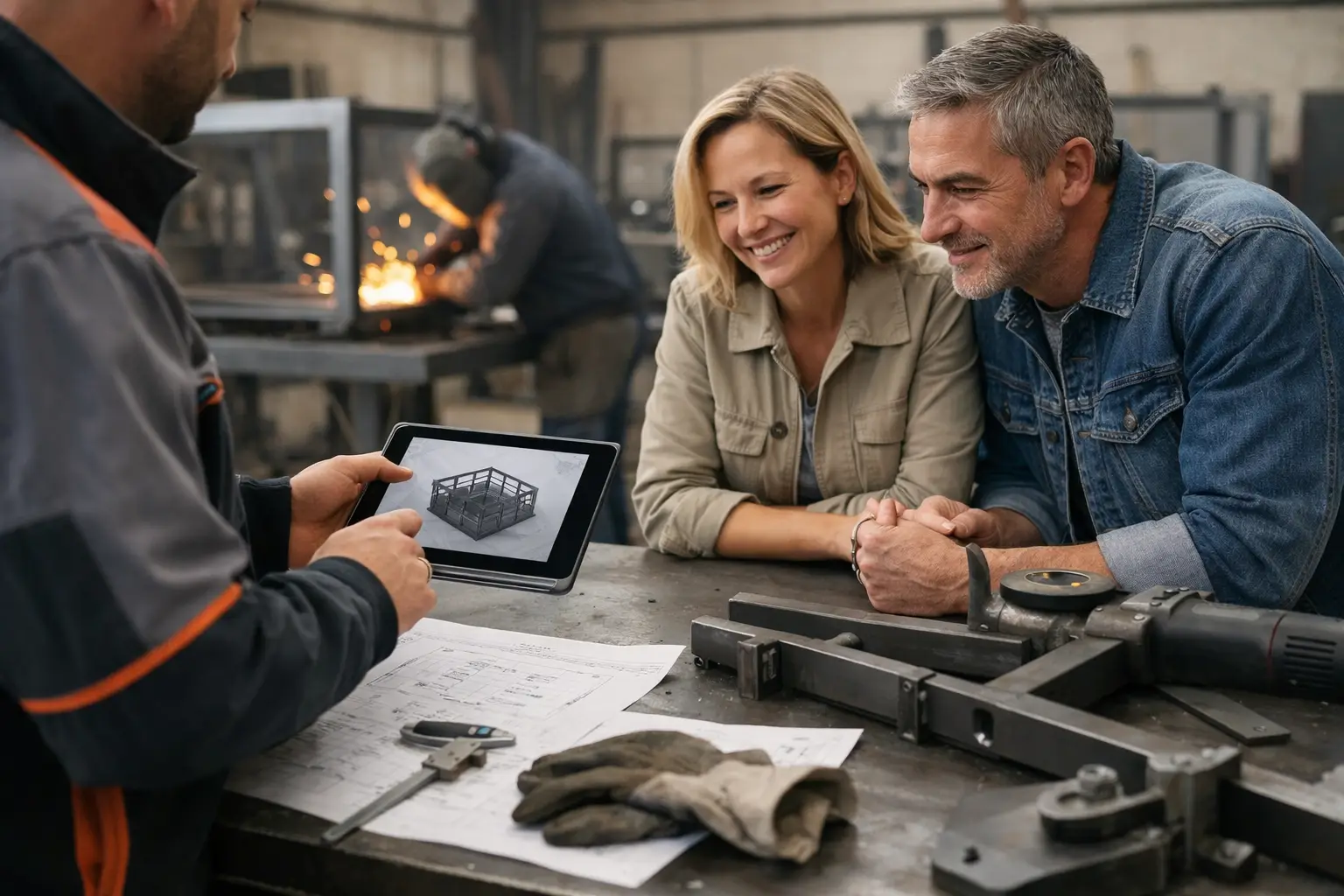
Client Updates for Metal Fabrication Projects
A fabrication job can look unchanged for days, then suddenly move fast. To your team, that rhythm is normal. To a client who approved drawings, paid a deposit, and is waiting on a delivery date, silence usually feels like delay.
That is why client updates for metal fabrication projects matter more than many shops realize. They are not just a courtesy. They are part of the service, especially when projects run for weeks, involve custom parts, or depend on multiple stages like design approval, material sourcing, cutting, welding, finishing, and installation.
CustomWorks.app
Keep clients updated without messy chats
Give each project a private feed for client updates — and keep a clear history of photos, videos, notes, stages, decisions, and delivery moments for your team.
For many fabrication businesses, the problem is not that they fail to communicate. It is that communication happens in fragments. A few photos go out by text. A change gets confirmed in email. A delivery question lands in WhatsApp. Someone on the floor tells the project manager the polishing is done, but that detail never reaches the client. The result is predictable: repeated status requests, avoidable confusion, and a project history that is hard to reconstruct later.
Good update habits fix that. More importantly, they change how clients experience your business.
Why client updates for metal fabrication projects affect trust
In metal fabrication, progress is often technical, not obvious. A client may understand the final product, but not the significance of nesting, fit-up, weld prep, coating lead times, or trial assembly. If they do not see movement, they often assume nothing is happening.
That assumption creates pressure on your team. Owners and project managers end up answering the same question in different places: Any updates? Each response takes only a few minutes, but the interruption cost adds up. It breaks focus, pulls information from production staff, and increases the chance that different people give slightly different answers.
Consistent updates reduce that friction because they make progress visible before the client has to ask. A short note with photos from the shop floor can do a lot of work. It shows that material arrived, parts were cut, welds are complete, or surface prep started. It also signals that the project is being managed in an organized way.
That matters even more when timelines shift. Fabrication projects are full of moving parts. A supplier delay, drawing revision, finish issue, or site readiness problem can affect delivery. Clients are usually more reasonable about delays than shops expect, as long as they are informed early and clearly. What damages trust is not always the delay itself. It is finding out late, after days of silence.
What clients actually want to see
Most clients do not want a full production report. They want enough visibility to feel confident that the project is under control.
In practice, that usually means a simple timeline of meaningful progress. Photos from fabrication stages are especially effective because they remove ambiguity. A client may not understand every process detail, but they can recognize that raw material became components, components became assemblies, and assemblies are moving toward completion.
Short written context matters too. A photo without explanation can create new questions. A better update says what the client is looking at, what was completed, and what happens next. For example, a note that structural frames passed fit-up and are now moving to finishing is more useful than just sending three workshop images with no description.
Clients also want to see decisions and changes captured clearly. If dimensions were revised, hardware changed, or a finish option approved, that should sit in the same visible record as the progress updates. Otherwise, important details stay buried in inboxes and message threads.
The best update flow is not complicated. It is visual, chronological, and easy to understand without a meeting.
The common mistakes that make updates harder than they need to be
Some shops avoid regular updates because they assume it will create more admin. That can happen, but usually only when the process is poorly defined.
One common mistake is waiting for big milestones. If your team only updates clients when a phase is fully complete, long gaps appear. In fabrication, those gaps can be misleading. There may be real work happening every day, but the client sees nothing until the end of the stage.
Another mistake is overexplaining. Technical detail has its place, especially for commercial buyers or experienced contractors, but most updates should stay practical. What was done, what is in progress, whether anything changed, and what comes next is often enough.
A third issue is spreading communication across too many channels. When updates live partly in email, partly in text messages, and partly in a shared drive, no one has a clean record. Your team wastes time finding the latest version of events, and clients are left piecing things together on their own.
Then there is inconsistency. One project gets weekly photos because the client asks often. Another gets almost nothing because the client is quiet. That approach is risky. Quiet clients still notice silence. They just raise concerns later, often when stress is already higher.
A practical approach to updates that works in fabrication
The most effective system is usually the simplest one your team will actually maintain.
Start by matching updates to the natural rhythm of a fabrication project. That could mean posting at key stages such as design sign-off, material arrival, cutting, assembly, welding complete, finishing, quality check, packing, dispatch, and installation. On longer jobs, a light weekly cadence between milestones helps prevent gaps.
Each update should answer three questions: what happened, what the client is seeing, and what comes next. That structure keeps communication short without being vague.
Photos should be standard, not occasional. You do not need polished marketing shots. Clear, honest progress images from the shop floor are usually better because they show real movement. A quick video can also help when the client needs to understand scale, mechanism function, or assembly progress.
It also helps to assign ownership. If everyone is responsible for updates, they often become nobody’s job. In many shops, the best model is for production staff to capture raw visuals and for one project lead or coordinator to post the client-facing update. That keeps the process accurate without turning welders or fabricators into administrators.
For businesses that want a more organized setup, a dedicated client update platform can make the process much cleaner. Instead of relying on scattered emails and chat threads, teams can keep photos, notes, milestones, changes, and delivery updates in one client-facing timeline. That is the core idea behind CustomWorks, which is designed for long-running custom projects where visibility matters but full project management tools are not the right fit. You can see the platform at https://customworks.app.
What a strong update process changes inside the business
The obvious benefit is fewer incoming status messages. That alone saves time. But the bigger gain is control.
When updates are structured, project communication stops depending on memory. You do not need to remember which image was sent, whether the finish change was confirmed, or when the client was told about a revised installation window. The record is already there.
That has operational value. If a team member is away, another person can pick up the conversation without guessing. If a question turns into a dispute, you have a clear timeline of what was shared and when. If the client comes back months later for a repeat order or modification, the visual history is easy to review.
There is also a commercial benefit. Clients judge professionalism partly by output, but also by process. A shop that communicates clearly often feels more reliable than one doing similar work with less structure. In competitive markets, that difference can influence referrals and repeat business.
Of course, there is a balance. Too many updates can create noise, especially if each post is minor or repetitive. Too few updates create uncertainty. The right cadence depends on project complexity, client type, and risk level. A high-value architectural metal package may need more structured visibility than a simple one-off bracket job. It depends on how long the project runs, how many decisions are involved, and how much coordination sits around the fabrication itself.
The standard clients remember
Clients rarely remember every technical step of a fabrication project. They remember whether the experience felt clear or unclear. They remember whether they had to chase for information. They remember whether changes were documented or buried in messages. And they remember how confident they felt while waiting.
That is what makes client updates for metal fabrication projects worth treating as part of delivery, not an extra admin layer. When the update process is simple, visual, and consistent, it reduces pressure on your team and gives clients a much better sense of progress without constant back-and-forth.
If your projects run longer than a few days, the silence between milestones is part of the job whether you manage it or not. The shops that handle it well tend to look more organized, keep trust steadier, and spend less time answering the same question again tomorrow.